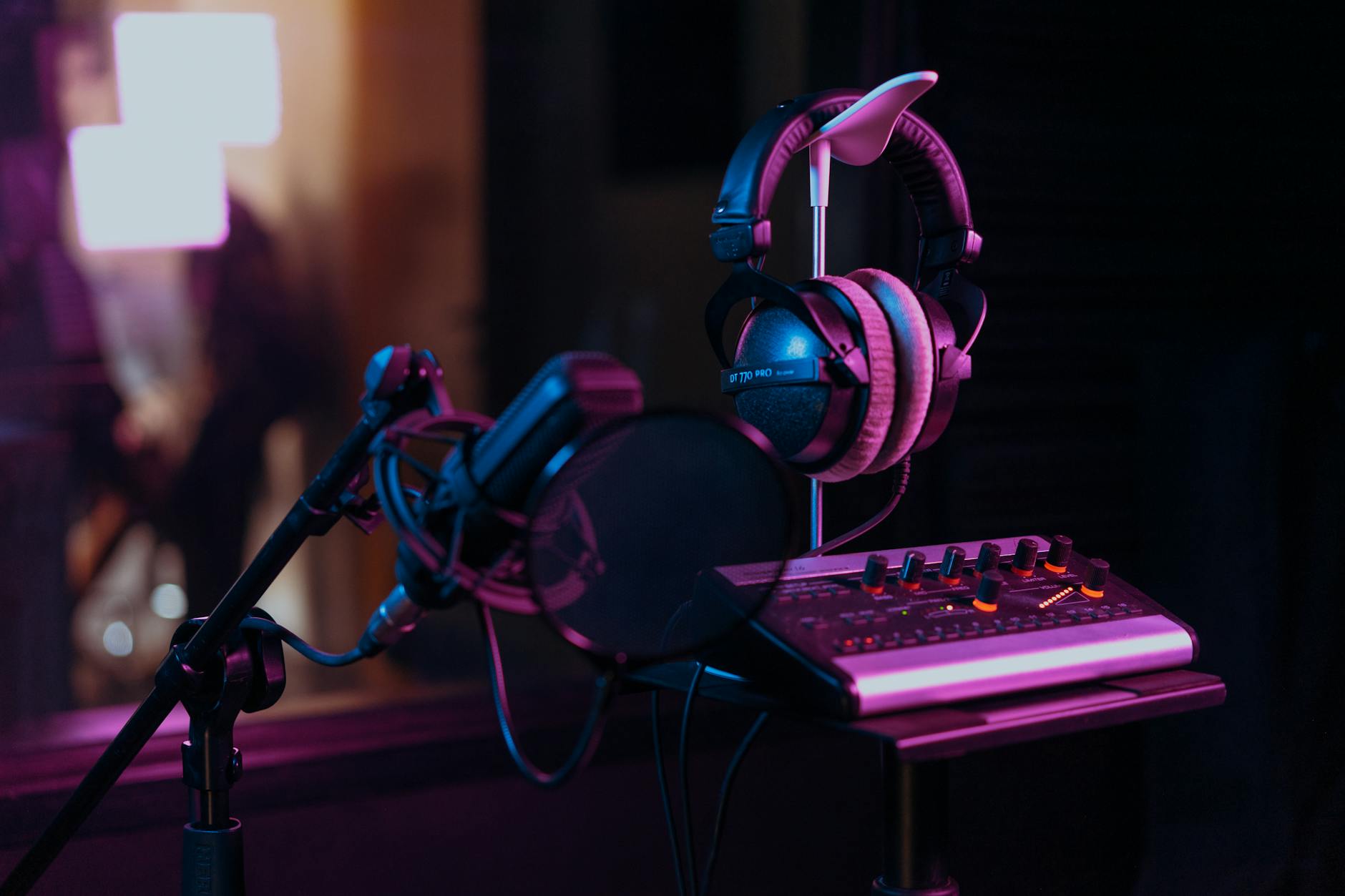
AI music is already in Nairobi.
Not as a future thing. Not as a foreign debate. Right now, Kenyan artists are using AI to test hooks, write rough lyrics, create demo melodies, imagine new Gengetone pockets, and hear what a Mugithi chorus might feel like before booking studio time.
That’s exciting.
It’s also risky if you don’t understand the law, ownership, consent, and what actually makes a song release-ready.
If you’ve been searching AI music Kenya, make a song with AI, is AI music legal in Kenya, recording studio near me, or how much does it cost to record a song in Kenya, this guide is for you.
At Studio 56 KE, a professional recording studio Nairobi artists can book via WhatsApp on +254 726 447 096, we’re seeing more musicians walk in with AI demos. Some are clever. Some are rough. Some have a big idea hiding inside a plastic-sounding draft.
That’s where the real work begins.
AI should not replace your thinking. It should deepen it. Use it to sharpen your taste, test directions, break a creative block, and hear possibilities faster. But the artist’s judgement is still the point. The voice, the story, the pocket, the emotion, the final mix, that’s human work.
Let’s answer the questions Kenyan artists are actually asking.
Can I legally use AI music tools in Kenya?
Short answer: yes, you can use AI music tools in Kenya, but you can’t use them to steal.
There’s nothing automatically illegal about using AI to sketch a beat idea, brainstorm lyrics, test a melody, or create a rough demo. If you’re writing a Gengetone hook and you ask an AI tool for five possible chorus directions, that’s a creative workflow. If you use AI to imagine the mood of an Afrobeats track before you enter the booth, that’s a sketching tool.
But Kenyan copyright law still matters.
The Kenya Copyright Act protects original creative works. KECOBO, the Kenya Copyright Board, exists for copyright administration and enforcement. MCSK, the Music Copyright Society of Kenya, is part of the royalty and rights conversation for musicians. So if your “AI song” is actually a clone of someone else’s track, a copied chorus, a recreated beat, or an unauthorised remix, you’re not being clever. You’re creating a legal problem.
Here’s the line: use AI to develop your own idea, not to reproduce another artist’s work without consent.
If you want to remix, sample, interpolate, or rework someone else’s song, get written permission. Don’t rely on “but I changed it with AI.” That won’t magically clear the rights. If you’re unsure, speak to KECOBO, MCSK, or a qualified copyright lawyer before you release on Boomplay, Mdundo, Skiza tunes, YouTube, TikTok, Audiomack, or anywhere else.
Elsewhere in the world, courts have made people pay serious attention to music rights. Robin Thicke and Pharrell Williams were found liable to Marvin Gaye’s estate in the “Blurred Lines” case, a warning about how copyright disputes can get heated around musical similarity (https://www.eff.org/deeplinks/2015/03/blurred-lines-copyright-verdict-bad-news-music). In RIAA v. Tenenbaum, a US court awarded 675,000 dollars, about 22,500 dollars per song, over music copyright infringement (http://arstechnica.com/tech-policy/news/2009/07/o-tenenbaum-riaa-wins-675000-or-22500-per-song.ars). A US jury also hit Cox Communications with a 1 billion dollar music copyright verdict (https://variety.com/2019/digital/news/cox-communications-music-copyright-suit-verdict-1203449254/).
Those are foreign cases, not Kenyan cases. But the lesson travels well: music rights are taken seriously worldwide, and Kenya’s Copyright Act protects Kenyan artists too.
There’s also balance. Ed Sheeran won his case over Marvin Gaye’s “Let’s Get It On” in 2023, showing that not every similarity is theft and courts can weigh musical evidence carefully (https://www.nytimes.com/2023/05/04/arts/music/ed-sheeran-marvin-gaye-copyright-trial-verdict.html). So don’t panic over every shared chord feeling. But don’t copy either.
Use AI like a notebook, not like a shortcut into someone else’s catalogue.
Which AI music tools actually work in Kenya, and what do they cost?
Kenyan artists have more options than before.
Google’s music and generative AI ecosystem is becoming more visible locally. Google’s MusicFX is built for music generation experiments (https://gemini.google/overview/music-generation/), and Google has also discussed creative tools like ImageFX and TextFX through Google Labs (https://blog.google/innovation-and-ai/products/google-labs-imagefx-textfx-generative-ai/). Gemini has a Kenya subscriptions page with pricing shown in KES, which matters because Kenyan users can check plans in local currency rather than guessing from foreign pricing pages (https://gemini.google/ke/subscriptions/?hl=en-GB). Google DeepMind’s Lyria is also part of Google’s music generation work (https://deepmind.google/models/lyria/).
You’ll also hear Kenyan producers talk about tools like Suno and Udio. Some use them for quick song sketches. Others use them to test melody directions, reference arrangements, or generate rough ideas before rebuilding the track properly in a DAW.
But cost is where you need to be careful.
AI tool prices can change. Plans can vary by country, account type, and product access. So don’t trust a random screenshot from someone’s WhatsApp group. Check the official pricing page for the exact tool you want to use. For Gemini, Google already has a Kenya subscriptions page in KES, so start there if that’s the ecosystem you’re considering.
For studio work, Studio 56 KE sessions start from Ksh 1,700/hr. That gives you a practical path: use AI at home to shape the rough idea, then come into a proper music studio Nairobi setup to record clean vocals, rebuild the beat if needed, mix, master, and prepare the song for release.
If you’re searching free recording studio in Kenya, be honest with yourself. Free can be useful for a quick favour or a raw phone demo. But if you want something you can confidently upload to Boomplay, Mdundo, Skiza, or pitch to DJs and content creators, you’ll need proper recording and finishing.
If you’re searching cheapest recording studio in Nairobi, don’t only ask, “What’s the lowest price?” Ask, “Will this sound good when played next to the artists I admire?”
Cheap that wastes your song is expensive.
How do I actually turn an AI idea into a real, release-ready song?
This is the part many artists skip.
AI can give you a spark. It can generate a demo that feels exciting at midnight in your bedroom. But a demo is not the same thing as a finished song.
A release-ready track needs intention.
Start with the idea. What’s the song about? Who is it for? Is it a club record, a heartbreak song, a gospel-inspired Afrobeats track, a Gengetone street anthem, a Kikuyu Benga update, or an Amapiano Kenya groove?
Then check the hook. If people only remember one line, what should it be? AI can suggest lines, but you decide what sounds like you. Kenyan listeners can smell fake from far. If the Sheng is off, if the Kiswahili is stiff, if the Kikuyu phrase sounds pasted in, fix it before you record.
Next, rebuild the arrangement. Many AI demos sound impressive for a few seconds but fall apart when you listen deeply. The drums may not hit right. The bass may be muddy. The chorus may not lift. The transitions may feel random. A producer can take the useful parts and shape them into a track that breathes.
Then record real vocals. This is where a proper recording studio near me search becomes important. Your vocal is the emotional signature of the song. It needs the right mic, the right booth, the right performance direction, and an engineer who knows when to push you for one more take.
At Studio 56 KE, we help artists bring raw ideas into the room and leave with something stronger. You can come with an AI demo, a voice note, a YouTube-type reference, a chorus idea, or just a concept. We’ll help you structure it, record it, clean it, and finish it.
Mixing and mastering is not decoration.
If you’re searching mixing and mastering Nairobi, you already understand that the final sound matters. Mixing balances your vocals, beat, effects, drums, ad-libs, and space. Mastering prepares the final track so it translates better across phones, cars, clubs, headphones, and streaming platforms.
A song can have a brilliant idea and still fail because the mix is weak.
So the smarter workflow is simple: use AI for pre-production, then use real ears and real engineering for the final product.
AI can help you start. A studio helps you finish.
Can AI help with Kenyan sounds like Gengetone, Mugithi, Benga and Afrobeats?
Yes, but don’t let it flatten the culture.
AI can help you sketch ideas for Gengetone, Mugithi, Kikuyu Benga, Afrobeats, and Amapiano Kenya. It can help you test tempos, moods, chord colours, lyric angles, and melodic ideas. If you’re stuck, it can push you into a direction you hadn’t considered.
But Kenyan music is not just a list of genre labels.
Gengetone has attitude. It has slang, humour, street timing, chant energy, and a certain rawness that doesn’t come from a prompt alone.
Mugithi has motion. It carries guitar feel, storytelling, call-and-response energy, and a social warmth that makes sense in real gatherings, not just on a screen.
Kikuyu Benga has touch. The groove, guitar language, vocal phrasing, and rhythmic confidence need musicianship.
Afrobeats and Amapiano Kenya need pocket. The drums may look simple in a grid, but the feel is everything. If the log drum, percussion, bass, and vocal phrasing don’t sit right, the track won’t move people.
That’s why AI should deepen your thinking, not replace it.
A weak artist asks AI to do everything. A sharp artist asks better questions. What if the Mugithi guitar talks back to the chorus? What if the Gengetone hook is shorter and more repeatable? What if the Amapiano Kenya groove leaves more space for the vocal? What if the Benga influence is in the guitar phrasing, not a costume thrown on top?
That’s taste.
And taste is what separates a throwaway AI experiment from a song people replay.
If you’re a Kenyan artist, don’t use AI to sound less Kenyan. Use it to explore your Kenyan-ness with more range. Bring your references, your language, your neighbourhood, your humour, your story, and your real voice into the process.
The machine can suggest. You must choose.
Who owns an AI-generated song, and is it legal to remix or rework someone else’s track with AI?
Ownership is the question that can save you pain later.
If you write original lyrics, create original melodies, record your own vocals, build original production, and use AI only as a tool in your process, you’re in a safer creative position. But AI platforms may have their own terms about what you can do with generated outputs, especially for commercial release. Read the terms before you upload the track to platforms.
Don’t assume. Check.
Also, keep records. Save your lyrics, project files, stems, voice notes, session dates, collaborator names, split sheets, and permissions. If someone later asks who contributed what, you don’t want to rely on memory.
The bigger danger is unauthorised remixing.
If you take another Kenyan artist’s song and use AI to change the voice, flip the beat, extend the chorus, generate a “new” version, or make a fake collaboration, that can still infringe rights. If you sample a Mugithi classic, rework a Benga guitar line, clone a Gengetone artist’s voice, or interpolate a chorus from someone else’s Afrobeats track, get consent.
Written consent. Not vibes. Not a DM with fire emojis. Not “tuliongea.”
You need proper permission or licensing from the rights holder. When unsure, consult KECOBO or MCSK before release. It’s better to delay a drop than to lose the song later, fight with collaborators, or damage your name.
Here’s a quick checklist before you remix or release:
- Get written consent for samples, remixes, interpolations, and reworks
- Keep your stems and project files so your creative process is clear
- Credit collaborators properly, including writers, producers, vocalists, and session musicians
- Register and document your work through the right Kenyan channels, including MCSK and KECOBO where applicable
- Read the AI tool terms before using generated material commercially
- Book a studio to finish it, especially for vocals, mixing, mastering, and final quality control
A clean release is not just about sound. It’s about ownership.
If the song blows up on TikTok, gets picked for Skiza tunes, starts moving on Mdundo, or gets attention from DJs, that’s when messy paperwork becomes expensive emotionally, creatively, and legally.
Handle it early.
Your best protection is clarity. Who wrote what? Who produced what? Who owns the beat? Who cleared the sample? Who approved the remix? Who gets credited? Who gets paid?
Those questions are not boring. They’re part of being a professional artist.
AI music in Kenya is not the enemy. Lazy music is. Stolen music is. Hollow music is.
Used well, AI can help a Nairobi artist move faster from idea to direction. It can help a producer test sounds before a session. It can help a songwriter break through a blank page. It can help a fan become a creator.
But the final song still needs a human centre.
Your voice. Your taste. Your story. Your people. Your paperwork.
If you’ve got an AI demo, a raw hook, a voice note, or even a half-formed idea, bring it to Studio 56 KE. We’ll help turn it into a finished, properly-owned track with real recording, vocals, mixing, and mastering.
Looking for a music studio near me, recording studio Nairobi, or mixing and mastering Nairobi?
WhatsApp Studio 56 KE on +254 726 447 096 and book your session. Sessions start from Ksh 1,700/hr.